Carbon footprinting
basics for Australian producers.
Carbon footprinting is becoming a practical business requirement for many producers — driven by customer expectations, supply-chain pressure, reporting needs, export markets and the need for credible sustainability claims.
The most cost-effective approach is not always the most detailed one. The key is to choose the right level of analysis for the question your business actually needs to answer.
Fit-for-purpose analysis
Choose the method that answers the decision — without over-engineering the task.
What carbon footprinting is — and why it matters now.
Carbon footprinting is the process of quantifying greenhouse gas emissions associated with a business, product or activity.
For many Australian producers, the need now comes from practical business pressures rather than theory: customer requests, supply-chain reporting, investor questions, export-market requirements and the need to communicate sustainability claims credibly.
The challenge is that “carbon footprinting” can mean different things. Sometimes you need a corporate footprint. Sometimes you need the footprint of a specific product. Sometimes carbon is not enough and a full life cycle assessment is more appropriate.
Three common levels of analysis.
Corporate carbon footprint
Measures emissions associated with operating the business over a reporting period.
Best used for company baselines, hotspot identification, customer requests, target setting and reporting preparation.
Product carbon footprint
Measures the embedded greenhouse gas emissions associated with a specific product.
Best used when the question is about a product, packaging format, ingredient choice, procurement requirement or product-level customer disclosure.
Full life cycle assessment
Goes beyond carbon to consider a broader range of environmental impacts.
Best used when wider trade-offs matter or when stronger comparative product work is required.
Company-level emissions with defined boundaries.
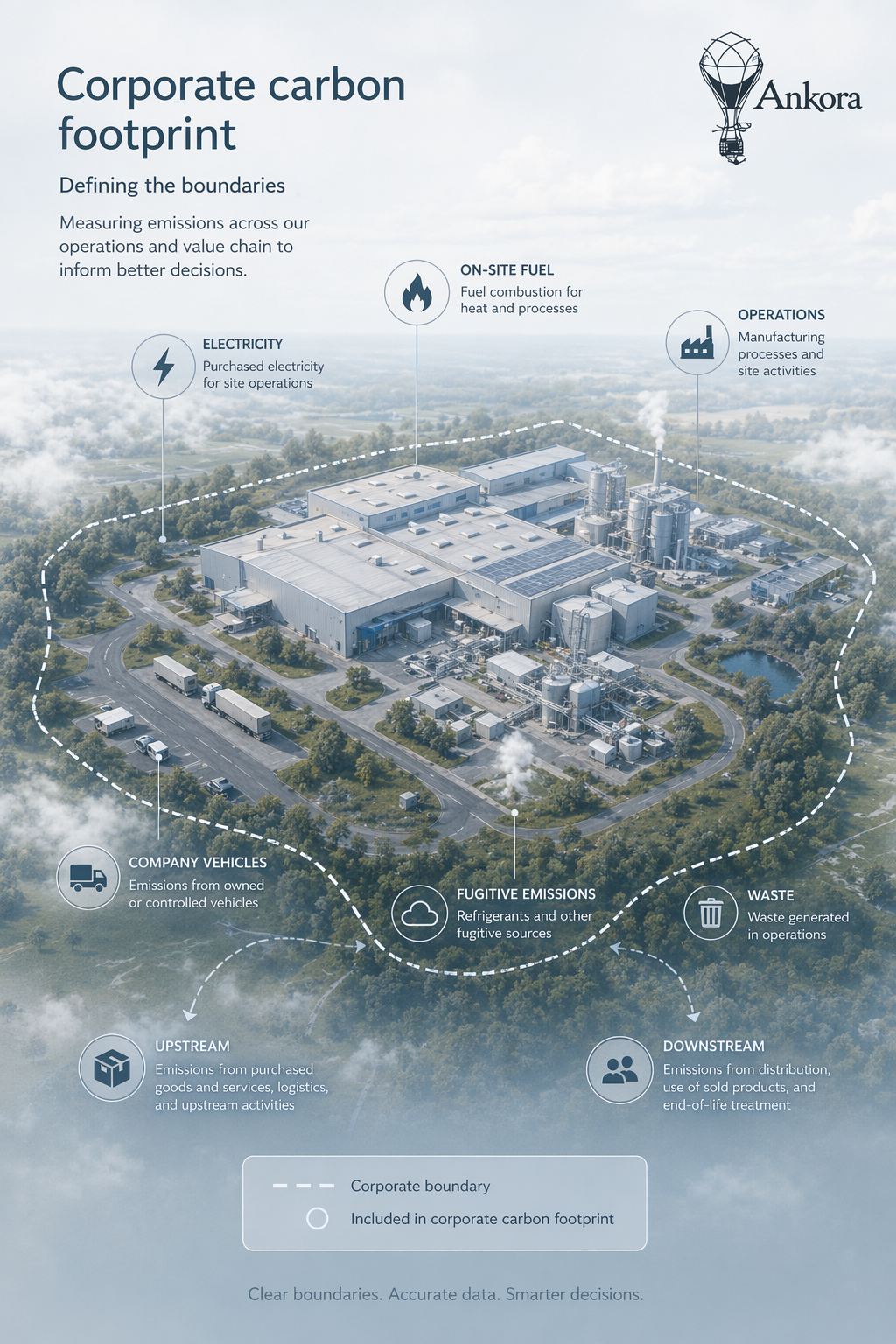
A corporate carbon footprint measures emissions associated with operating a business over a defined reporting period.
It usually starts by setting organisational boundaries — which entities, sites or operations are included — and operational boundaries — which emission sources are included.
Scope 1 covers direct emissions from owned or controlled sources. Scope 2 covers indirect emissions from purchased electricity, steam, heat and cooling. Scope 3 covers other indirect emissions across the value chain.
This approach is usually the right starting point when a business needs a baseline, wants to identify hotspots, is responding to customer requests, or is preparing for company-level reporting.
Relevant references commonly include the GHG Protocol Corporate Standard, Scope 2 Guidance, Scope 3 Standard and, in Australia, the NGER framework where reporting thresholds apply.
Embedded carbon in a specific product.
A product carbon footprint measures emissions associated with a specific product across defined life cycle stages.
Depending on the purpose, boundaries might be cradle-to-gate or cradle-to-grave. Product footprints are useful where procurement, product design, packaging choices, export-market questions or customer disclosure depend on the carbon profile of a specific product.
Relevant references commonly include ISO 14067 and the GHG Protocol Product Standard.
This is also where it is useful to distinguish product footprints from corporate emissions intensity metrics such as tonnes of CO₂-e per tonne, litre, hectare or unit produced. Intensity metrics can be valuable for internal tracking and benchmarking, but they are not the same as full product footprints.

When carbon is not the whole story.
A full life cycle assessment goes beyond climate change alone. It is used when the broader environmental profile of a product matters, or when a business needs to understand trade-offs across multiple impact categories.
Relevant references commonly include ISO 14040 and ISO 14044. Depending on the impact assessment method used, such as ReCiPe, assessment can extend beyond climate change to other environmental categories such as water use, freshwater and marine eutrophication, acidification, land use, and resource scarcity or depletion. The categories included depend on the goal and scope of the study.
In practice, that means a lower-carbon option is not automatically the better environmental option overall. It may reduce emissions while increasing impacts in other areas such as water demand, nutrient pollution in freshwater or marine systems, land use, or resource pressure.
Emerging requirements in Australia and export markets.
Australia
In Australia, carbon footprinting may be driven by NGER obligations for businesses above reporting thresholds, climate-related disclosure expectations for larger entities, customer requests from within supply chains, and the need to support credible environmental claims.
Even where formal reporting does not apply directly, smaller producers are increasingly asked for climate-related information by larger customers, financiers and other stakeholders.
Export markets
In export markets, the pressure is often indirect but growing. Larger overseas customers may need sustainability data from suppliers to support their own reporting and procurement decisions.
In some sectors, product-level embedded carbon data is becoming more relevant to trade, procurement and market access discussions.
Start with the question your business actually needs to answer.
If the need is company reporting, hotspot analysis or reduction planning, start with a corporate footprint.
If the need is to understand the embedded carbon of a specific product, move to a product carbon footprint.
If the need is to understand broader environmental trade-offs, then a full LCA may be justified.
The goal is not maximum complexity. It is credible information that supports better decisions, stronger market positioning and practical improvement.
“The most cost-effective approach is usually the one that is fit for purpose — credible, useful and no more complex than necessary.”
Need help choosing the right footprinting approach?
Ankora helps producers choose the right level of analysis, build fit-for-purpose carbon footprints and turn sustainability requirements into practical commercial outcomes.